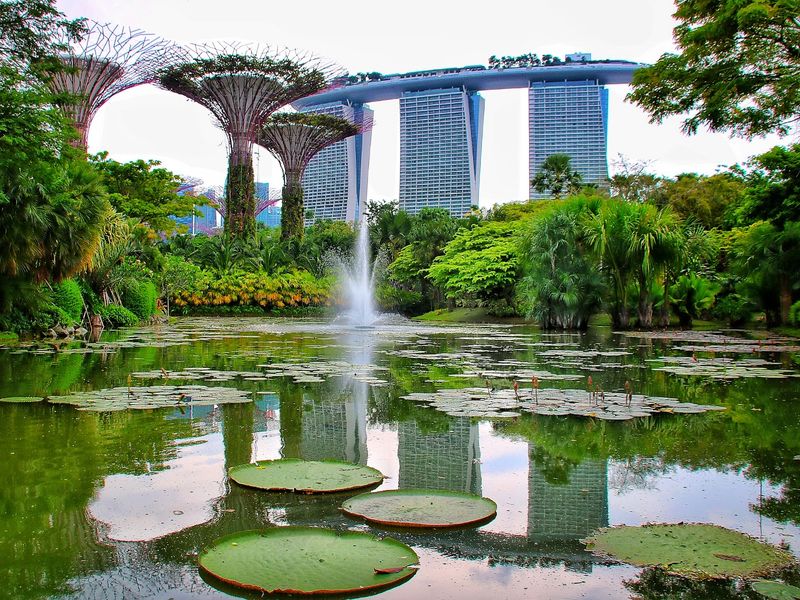
Singapore for solo women
A city where you can eat alone at a hawker centre at midnight and nobody thinks twice about it.
Singapore is a city that runs on precision. The MRT is air-conditioned and on time. Sidewalks are wide and well-lit. Signs are in English. The logistics of solo travel here are about as low-friction as it gets anywhere in Asia.
Hawker centres are the social infrastructure. You share tables with strangers. Nobody minds if you're alone. Ordering from a stall, finding a seat, eating well for the cost of a drink in most Western cities, this is daily life here, not a tourist activity.
The city packs a lot into a small footprint. Colonial architecture in the Civic District sits minutes from the glass towers of Marina Bay. Kampong Glam feels entirely different from Tiong Bahru. A week is enough to move between these pockets slowly.
Why Singapore
Singapore has some of the densest foot traffic and street lighting of any city in Southeast Asia. The MRT runs until after midnight on weekends, and Grab is reliable at any hour. English is an official language, which removes a layer of friction that solo women often carry in neighboring countries.
Where to go in Singapore
Getting around Singapore
The MRT connects the airport to the city center in under 30 minutes. Within Singapore, the MRT and buses cover almost everywhere worth going. Top up a stored-value card at any station machine. Grab fills the gaps when you're not near a station. Avoid metered taxis from Changi Airport, the queue is long and the Grab pickup works out faster.
When to visit Singapore
February and March tend to be drier, lower humidity than the rest of the year. November through January is the northeast monsoon season. Rain comes in sudden, heavy downpours rather than all-day drizzle. Carry a packable rain jacket regardless of the month. Avoid the Formula 1 Grand Prix weekend in September if you're watching your accommodation budget.
Local knowledge
- Visa-free entry for most Western, EU, and Australian passport holders for 30 or 90 days. Check the ICA website for your specific passport. No visa on arrival form to fill out, just a biometric scan.
- Get a Singtel or StarHub SIM at the airport arrivals hall before you leave Changi. Data is fast and affordable. Your hotel's WiFi is unnecessary.
- Chewing gum is not sold here and hasn't been since 1992. This is not an urban legend. Don't bring it in large quantities.
- Eating and drinking on the MRT is a fineable offense. The fine is real. So is the air conditioning, which makes it tempting to linger.
- Hawker centres don't take card at most stalls. Carry some cash. ATMs are everywhere and don't typically charge fees if you use a bank card rather than a credit card.
- The heat is constant. Average daily temperature hovers around 31C year-round. Cotton and linen breathe better than anything synthetic. Air conditioning in malls and MRT stations runs extremely cold, a light layer is useful.
- Tipping is not practiced here. At hawker centres, at restaurants, in taxis. It won't cause offence but it's not expected and not the norm.
Singapore travel FAQ
Can I eat alone at hawker centres without feeling out of place?
Yes. Solo dining is completely ordinary here. Hawker centres use communal tables, so you'll likely be sitting next to strangers whether you want to or not. It's one of the easiest cities in Asia to eat alone without any social friction.
What's the dress code for temples and mosques?
Cover your shoulders and knees before entering. Sri Mariamman Temple in Chinatown and the Sultan Mosque in Kampong Glam both have sarongs available to borrow at the entrance. It takes 30 seconds and costs nothing.
How do I get from Changi Airport to my accommodation?
The MRT Jewel line runs directly from the terminal into the city. A Grab from the airport is also straightforward. Use the Grab app, book from the designated pickup zones outside arrivals, and you'll have a fixed price before you get in the car.
Is it worth getting a hotel versus a hostel here?
Depends on what you want. Hostels in Kampong Glam and Chinatown put you in walking distance of a lot. Hotels in Marina Bay are expensive and somewhat removed from the neighborhood-level city. Tiong Bahru and Tanjong Pagar have mid-range boutique options with good MRT access.
What apps actually get used day-to-day?
Grab for rides and food delivery. Google Maps works well for MRT routing. The official SingPass app is for residents, you don't need it. Some hawker centres have their own ordering apps but most still work face-to-face.
What neighborhoods are worth staying in versus just visiting?
Tiong Bahru is well-connected and has good street-level walkability. Kampong Glam has foot traffic until late and restaurants that stay open past midnight. Marina Bay is impressive to walk through once. Most people staying there end up taking the MRT everywhere anyway.
Get the full guide in the Sola app
Neighborhood-level detail, offline access, and community insights from women who have been there.